
The Problem
Healthcare data is among the most complex, high-stakes information in any organization. Physicians, organizations, payments, referral networks, and outcomes are all deeply interconnected — but that richness comes at a cost. For most healthcare technology companies, accessing meaningful insights from this data requires technical specialists who know how to write queries, navigate relational database schemas, and stitch together answers from multiple sources. Business users — analysts, account managers, even executives — are effectively locked out.
The consequences are real and compounding. When a non-technical team member needs a data answer, they either wait in a queue for an analyst, make decisions without the data they need, or spend hours manually pulling and reconciling information from disparate systems. For companies serving large enterprise clients like pharmaceutical manufacturers or health systems, this bottleneck doesn't just slow down internal operations — it degrades the quality of the product they deliver.
Scaling this problem makes it worse. As a healthcare data company adds clients, each with unique reporting needs and varying levels of data sophistication, the demand on technical resources grows linearly while the ability to serve that demand stays flat. Security and multi-tenancy requirements add further complexity: every client needs isolated, auditable access. Without a smarter architecture, growth itself becomes the enemy.
The Solution
AI-powered data agents represent a fundamental shift in how organizations interact with complex, multi-source data. Rather than requiring users to understand data structures, write queries, or know which database holds which information, a data agent acts as an intelligent intermediary — translating natural language questions into precise data retrieval operations and returning clear, context-rich answers.
At its core, this approach combines several capabilities working in concert. A large language model interprets the user's intent, understanding domain-specific terminology and ambiguous phrasing. A relationship-aware reasoning layer maps entities across multiple databases — understanding, for example, that a question about a physician's payment relationships requires joining data across three separate tables. The system then synthesizes the results into a coherent, human-readable response, surfacing the insight rather than the raw data.

What makes this production-viable for enterprise healthcare is the architecture around it: multi-tenant access controls that ensure client data isolation, integration with enterprise identity providers for authentication, and guardrails that prevent the system from returning inaccurate or out-of-scope responses. The goal is not just to make data accessible — it's to make it trustworthy.
ROI & Business Value
| Outcome | Impact |
|---|---|
| Time reclaimed | 100+ hours of manual data analysis eliminated per month |
| Speed to insight | Business users get answers in seconds instead of days |
| Technical dependency | Non-technical users operate independently, no analyst required |
| Deployment speed | Production-ready proof of concept achievable in weeks, not quarters |
| Scalability | Single platform serves multiple enterprise clients simultaneously |
| Decision quality | Stakeholders act on complete, cross-database insights rather than partial views |
| Competitive positioning | Data accessibility becomes a differentiator in client retention and acquisition |
The compounding effect here matters: when analysts are no longer fielding repetitive data requests, they redirect their capacity toward higher-value work — building models, identifying trends, and supporting strategic decisions rather than running the same ad hoc queries week after week.
Practical Implementation Guide
Audit your current data request volume. Quantify how many hours per week are spent fulfilling data requests from non-technical stakeholders. This becomes your baseline ROI case and helps prioritize which query types to automate first.
Map your data relationships. Before any AI layer can work reliably, you need a clear entity-relationship model. Document how your key data entities connect across systems — this is the foundation for accurate, cross-database responses.
Define your user personas and query patterns. Identify who will use the system and what questions they actually ask. Grouping queries by type (e.g., lookup, aggregation, comparison, trend analysis) helps you design the agent's reasoning paths and test coverage.
Choose a foundation model and cloud infrastructure. Select an LLM with strong structured-data reasoning capabilities and deploy it within an architecture that supports your data residency and compliance requirements. Enterprise healthcare typically demands that data stay within controlled infrastructure.
Build and test your security and access control layer first. Multi-client environments require rigorous tenant isolation. Implement role-based access controls and test them before enabling any natural language query capability — security is not a post-launch consideration.
Start narrow, then expand. Launch with a limited set of high-frequency, well-defined query types. Validate accuracy against known answers, gather user feedback, and iterate before broadening scope.
Instrument for observability. Log queries, responses, and confidence signals. This data is essential for improving accuracy over time and for demonstrating compliance with audit requirements in regulated industries.
Train users, not just the model. Roll out with structured onboarding that shows business users how to ask effective questions. Natural language interfaces are intuitive — but setting expectations about scope and accuracy builds trust faster.
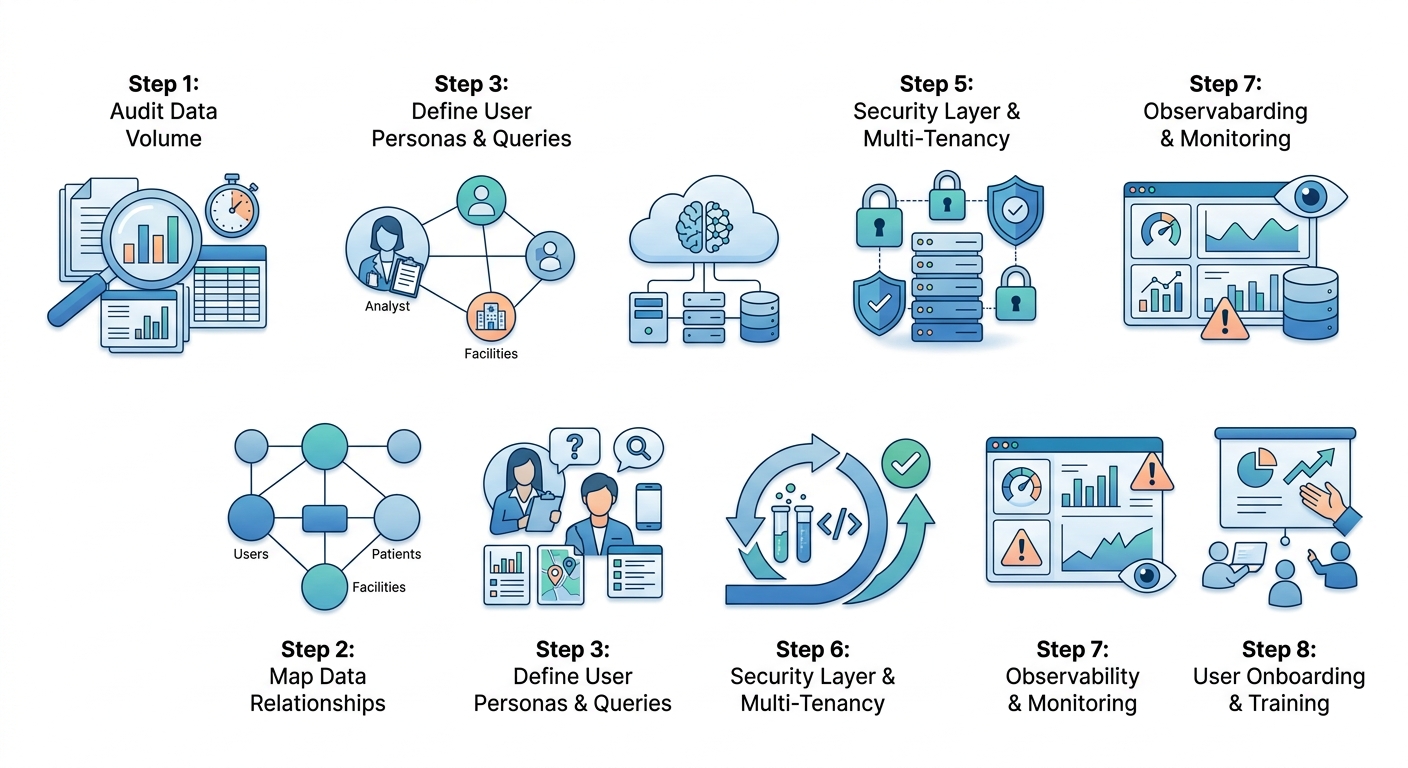
A linear 8-step workflow diagram starting from data auditing and relationship mapping, moving through infrastructure setup and security layer building, and ending with iterative testing and user onboarding.
